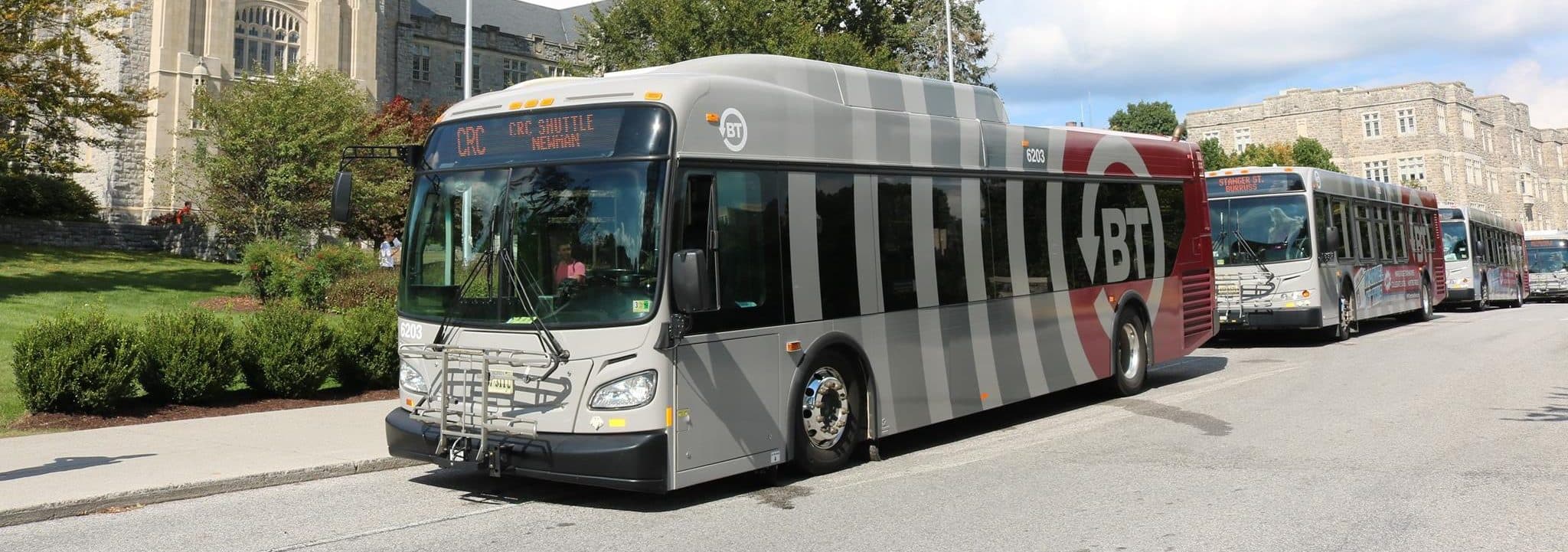
Blacksburg Transit
Blacksburg Transit
Rebuilding trust in transit for 400,000 monthly riders, from planning a trip to trusting the bus actually arrives.
Blacksburg Transit is the primary way Virginia Tech students get around — nearly 400,000 passengers a month. But the app meant to support that ridership was making things worse: inaccurate bus times, a confusing interface, and unreliable information left students late to class and distrustful of the system. As Lead UX Researcher, I drove the research that grounded a focused app redesign aimed squarely at rebuilding that trust.
Students can’t trust their transit app — and it’s disrupting their entire day
Blacksburg Transit (BT) is the primary transportation method for Virginia Tech students, serving nearly 400,000 passengers monthly. But the app meant to support that ridership was making things worse — inaccurate bus times, a confusing interface, and unreliable information left students arriving late to class, missing connections, and losing trust in the system.
With ridership growing 6% year-over-year, BT was scaling demand on top of a system that was already failing its core users.
Monthly passengers relying on BT to get across campus and town.
Year-over-year ridership growth, adding pressure to a failing system.
The transit app is students’ primary planning tool — and their biggest frustration.
How might we redesign the BT app to provide reliable, real-time information that students can actually trust?
Improve accuracy of bus arrival predictions.
Simplify the interface for quick, on-the-go use.
Rebuild user trust in the transit system.
Support growing ridership with better UX.
We went to the source: bus stops, frustrated students, daily commuting
As Lead Researcher, I owned the interview process end-to-end and later led the evaluation sessions during testing. We grounded every finding in real rider behavior — not assumptions — and confirmed Blacksburg’s problems weren’t unique: unreliable transit apps are a widespread industry challenge.
15 one-on-one rider interviews, plus 45 minutes of contextual field research observing behavior at Burrus Hall, a primary BT hub.
Primarily undergraduate riders — covering frequency of use, specific app frustrations, and desired features.
Students don’t want a perfect app — they just want to know when the bus is actually coming.
“The app lies to me constantly”
Frequent discrepancies between predicted and actual arrival times caused missed buses and late arrivals.
“I can’t figure out which bus to take”
A cluttered interface made route planning difficult under time pressure.
“I just stopped using it”
Many riders had abandoned the app entirely, defaulting to arriving early and waiting indefinitely.
Rely on the app as their primary planning tool — most affected by inaccurate ETAs.
Use the app inconsistently, often distrust it after one bad experience and revert to guessing schedules.
Riding between classes — need at-a-glance clarity, not detailed route exploration.
From ambitious vision to focused execution
Our initial concept paired an app redesign with physical monitors installed at bus stops. But as a class project with a single semester and no real budget or installation access, the monitors weren’t cost-effective. The team made a scoping decision to focus entirely on the app — which could deliver immediate impact to all ~400,000 monthly riders without infrastructure investment.
Process: Early sketches → Balsamiq wireframes → think-aloud usability sessions → high-fidelity prototype. We established information architecture and core functionality in Balsamiq, ran think-aloud sessions to surface friction before high-fidelity design, and storyboarded key journeys to keep the design tied to real commuting scenarios.
Improve app reliability with accurate real-time updates.
Simplify the layout for at-a-glance information.
Add a user guide for first-time users.
Display accurate bus stop information with live tracking.
Show bus capacity so users can plan for crowded buses.
A cleaner, faster, more trustworthy transit experience
The final high-fidelity Figma prototype carried the research through to a clear, trustworthy flow — trading scheduled guesses for live, GPS-grounded information.
Click here to see the flow of the final prototype →Live bus locations with ETAs based on GPS data, not scheduled times.
Clear visual hierarchy for finding your bus at a glance, even while rushing.
Shows crowding levels to help riders decide whether to wait for the next bus. Backend implementation was flagged as a follow-on technical question beyond this project’s scope.
First-time user tutorial to reduce confusion and improve adoption.
Rider feedback validated our approach
We ran qualitative evaluation sessions with ~20 BT riders, comparing expected vs. actual interactions with the prototype.
- Interface was significantly clearer and easier to navigate.
- Real-time tracking addressed the primary pain point of unreliability.
- Simplified design reduced cognitive load during stressful commutes.
- Handle edge cases (delays, route changes) more clearly in the UI.
- Backend performance to support real-time data at scale.
- Continued refinement of prediction accuracy.
What I’d carry forward
We delivered a working high-fidelity prototype addressing core rider pain points, and a scalable design foundation that could evolve with growing ridership.
Scope creep is real, and recognizing it is crucial. Pivoting away from physical monitors to focus on the app was a critical lesson in strategic, cost-aware design thinking.
Iteration isn’t failure, it’s progress. Moving from sketches to wireframes to high-fidelity, testing at each stage, required patience and a willingness to revisit decisions.
User research grounds every decision. Direct rider interviews and field observation surfaced friction no survey could have captured.
Collaboration amplifies creativity. A team of four brought diverse perspectives that produced a stronger outcome than any one person could alone.